

Sleep & Health Guide Case Study
Overview
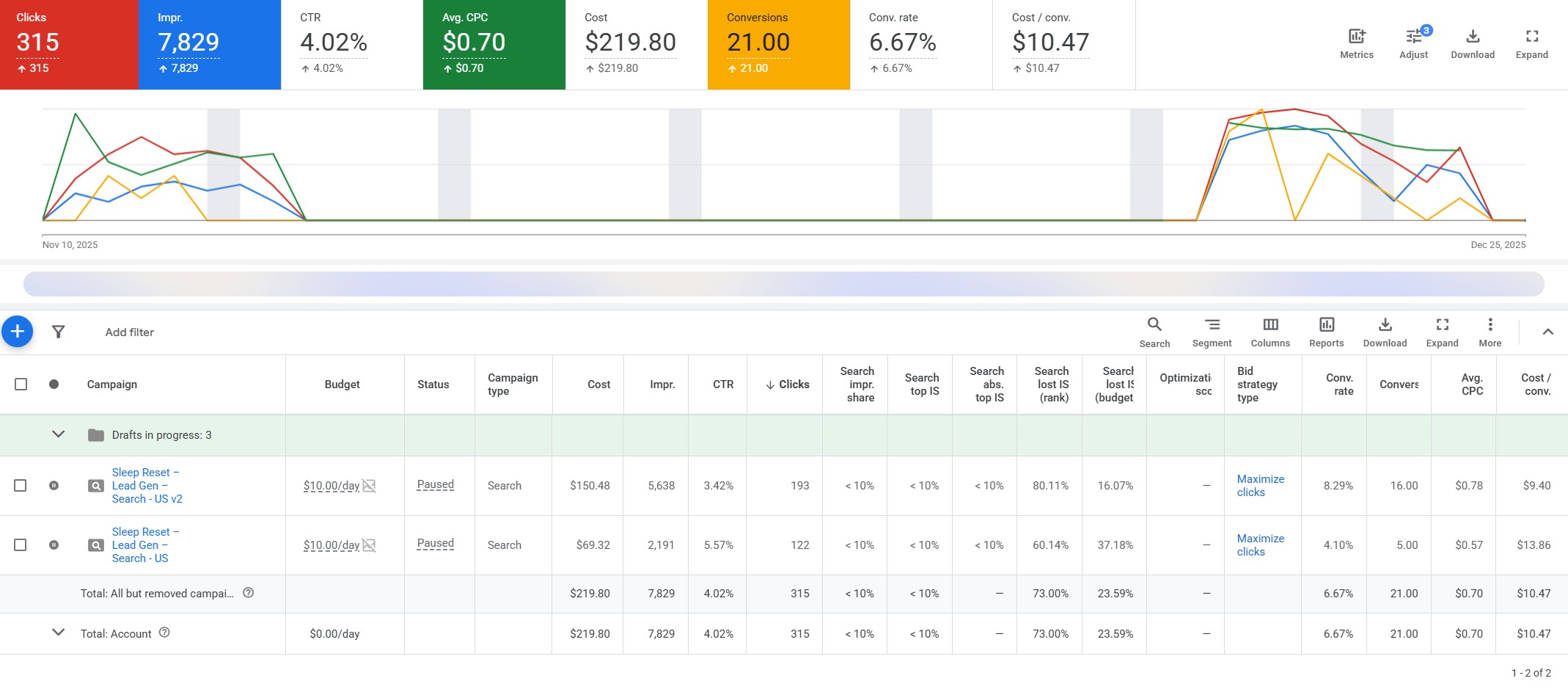
21 New Subscribers at $220 Ad Spend
Used Google Search Ads (RSAs) and a custom WordPress landing page to convert cold traffic into email subscribers through a free “7-Day Sleep Reset” PDF on a $10/day budget with zero prior campaign data.
$10.47
Cost Per Lead (CPL)
$0.70
Avg Cost Per Click (CPC)
4.02%
Click Through Rate (CTR)
6.67%
Conversion Rate
The Challenge
Starting From Zero
Sleep & Health Guide is a WordPress blog I built covering sleep health and wellness topics.
The goal was to grow an email list from scratch using paid search, with no existing audience, no conversion history, and a hard cap of $10 per day.
With no prior data to guide bidding or targeting, every decision had to be made with efficiency in mind. The low budget also limited data volume, making it critical to prioritize high-relevance traffic and avoid costly mistakes. There was no room for waste; every click had to count.
What I Was Optimizing For
The funnel was structured as:
Search → Click → Landing Page → Email Signup
I tracked key metrics at each stage of the funnel to evaluate performance:
CPC below $1.00
Why?
At $10/day, staying below $1 per click was the only way to generate enough volume to produce meaningful conversion data within budget.
CTR above 3%
Why?
Strong CTR signals keyword alignment and ad alignment, improves Quality Score, which lowers CPC over time. Critical when every dollar is accounted for.
Highest Conversion %
Why?
Conversion % shows how well the landing page and offer converted visitors into subscribers after clicking the ad. The higher it is, the more effective the offer and landing page.
Lowest CPA
Why?
CPA is the most important metric as it ties ad spend directly to the outcome. It’s the single metric that tells you whether the entire funnel from keyword to landing page is working properly.
What I Did, Step By Step
Built a keyword list around problem-aware intent
I targeted information-based queries from users already aware they had a sleep problem, not broad awareness terms. This kept CPCs low while reaching people most likely to download a free guide. Every keyword was filtered for ≥1k monthly search volume and competitiveness at or below $1 CPC.
View my entire Campaign structure and Setup here
Built a distraction-free landing page in WordPress
The landing page had no header, a minimal footer, and no navigation; the only action available was signing up. Copy was written to mirror keyword intent directly, addressing the user’s sleep pain point and presenting the 7-Day Sleep Reset PDF as the immediate solution.
Started with Maximize Clicks to gather data first
With zero conversion history, I opened with Maximize Clicks to build traffic efficiently before optimizing. I tested Maximize Conversions in the second campaign; performance declined, so I reverted. The data volume wasn’t there yet to support it.
Ran two campaigns, collected first, then optimized
The first 7 days were purely for data collection. After analyzing results, I tightened keyword-to-page relevance, updated landing page content for Quality Score, and re-launched for 8 more days with those adjustments applied.
Data Collection
Launched to generate initial performance data, clicks, CTR, and conversion behavior before making any optimization decisions.
$13.86
Average CPA
Optimization
Applied insights from Campaign 1, tighter landing page content, stronger keyword relevance, and refined bidding strategy based on what the data revealed.
$9.40
Average CPA (reduced 32%)
My Final Results
21
Subscribers acquired
$10.47
Average CPA
6.67%
Conversion rate
315
Clicks
$0.70
Avg CPC
4.02%
CTR
−32%
CPA reduction
Through landing page optimization and tighter keyword-to-page alignment, CPA dropped by 32% between the two campaigns without increasing the daily budget.
$13.86
Campaign 1 CPA
$9.40
Campaign 2 CPA
What I’d Do Next To Improve Performance
Tighten keyword → landing page alignment
Closer keyword-to-page relevance would lower CPCs and increase ad rank without raising the budget.
Add social proof to the landing page
Subscriber counts or testimonials would reduce friction for cold traffic and lift the conversion rate.
Segment landing pages per keyword group
Dedicated pages per keyword cluster would improve message match and boost Quality Score across the board.
Focus on lost Impression Share
Recovering lost impressions through Quality Score improvements would expand reach without increasing the daily budget.
What I Learned/Observed
Relevance drives efficiency.
Targeting problem-aware queries and aligning the keyword, ad, and landing page around one specific intent was the biggest lever for keeping CPA low.
The landing page is half the campaign.
Removing navigation and tightening copy to match keyword intent improved both conversion rate and Quality Score, which fed back into lower CPCs.
Small adjustments compound.
The changes between Campaigns 1 and 2 were minor, but they produced a 32% CPA reduction without touching the budget.
Start with traffic before conversions.
Switching to Maximize Conversions too early hurts performance. The algorithm needs more data before it can optimize effectively.
Skills I Utilized
Keyword Research
SEMrush & Google Keyword Planner to build and filter the campaign structure
Google Search Ads
RSA structure, bidding strategy, and two-phase campaign optimization
Landing Page Optimization
Custom WordPress page built and refined for conversion rate improvement
Conversion Tracking
Proper audience settings and placements to maximize results
CONTACT
Get in Touch
I’m always open to discussing new opportunities! Looking for agency media buyer roles, in-house roles, and contract roles.