
Sleep & Health Guide Case Study

Overview

LEAD GEN · GOOGLE SEARCH ADS · EMAIL FUNNEL

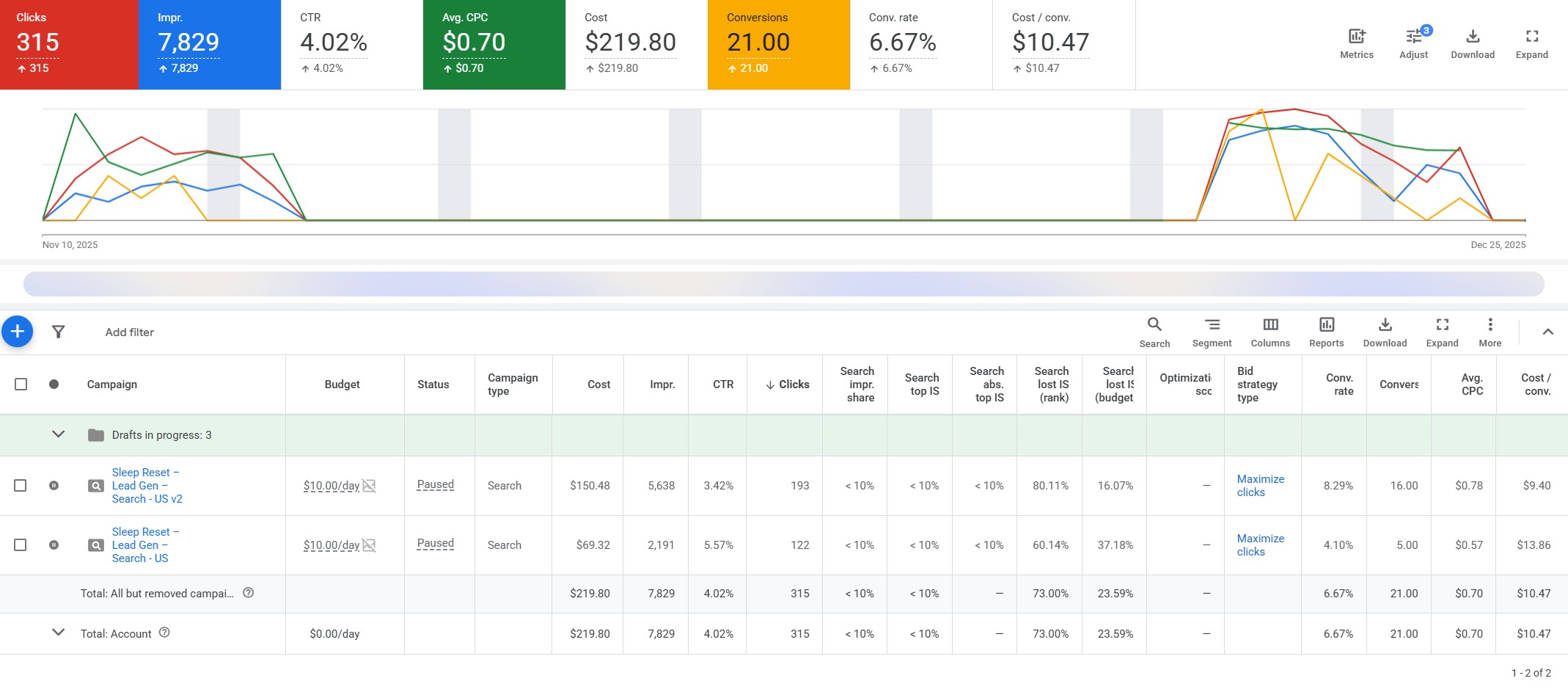
21 New Subscribers at $220 Ad Spend

Used Google Search Ads (RSAs) and a custom WordPress landing page to convert cold traffic into email subscribers through a free “7-Day Sleep Reset” PDF on a $10/day budget with zero prior campaign data.

$10.47

Cost Per Lead (CPL)

$0.70

Avg Cost Per Click (CPC)

4.02%

Click Through Rate (CTR)

6.67%

Conversion Rate

The Challenge

Starting From Zero

Sleep & Health Guide is a WordPress blog I built covering sleep health and wellness topics.

The goal was to grow an email list from scratch using paid search — with no existing audience, no conversion history, and a hard cap of $10 per day.

With no prior data to guide bidding or targeting, every decision had to be made with efficiency in mind. The low budget also limited data volume, making it critical to prioritize high-relevance traffic and avoid costly mistakes. There was no room for waste; every click had to count.

KPIs & Metrics

What I was optimizing for

Before the campaign launched, I set three clear benchmarks that would define success given the budget constraints.

CPC under $1.00

At $10/day, staying below $1 per click was the only way to generate enough volume to produce meaningful conversion data within budget.

CTR above 3%

Strong CTR signals keyword and ad alignment and improves Quality Score, which lowers CPC over time. Critical when every dollar is accounted for.

Lowest possible CPA

The north star combines keyword intent, ad relevance, and landing page performance to minimize the cost of each subscriber acquired.

Tracking & Measurement

The funnel was structured as:
Search → Click → Landing Page → Email Signup
I tracked key metrics at each stage of the funnel to evaluate performance:
CTR: Measured ad relevance and keyword alignment
CPC: Ensured efficient traffic acquisition within budget
Conversion Rate: Evaluated landing page and offer effectiveness
CPA: Determined overall campaign efficiency
These metrics allowed me to identify performance bottlenecks and optimize accordingly.

My Approach

The process, step by step

Built a keyword list around problem-aware intent

I targeted information-based queries from users already aware they had a sleep problem, not broad awareness terms. This kept CPCs low while reaching people most likely to download a free guide. Every keyword was filtered for ≥1k monthly search volume and competitiveness at or below $1 CPC.

Built a distraction-free landing page in WordPress

The landing page had no header, a minimal footer, and no navigation; the only action available was signing up. Copy was written to mirror keyword intent directly, addressing the user’s sleep pain point and presenting the 7-Day Sleep Reset PDF as the immediate solution.

Started with Maximize Clicks to gather data first

With zero conversion history, I opened with Maximize Clicks to build traffic efficiently before optimizing. I tested Maximize Conversions in the second campaign; performance declined, so I reverted. The data volume wasn’t there yet to support it.

Ran two campaigns — collected first, then optimized

The first 7 days were purely for data collection. After analyzing results, I tightened keyword-to-page relevance, updated landing page content for Quality Score, and re-launched for 8 more days with those adjustments applied.

Campaign 1 (7 Days)

Data Collection

Launched to generate initial performance data, clicks, CTR, and conversion behavior before making any optimization decisions.

$13.86

Average CPA

Campaign 2 (8 Days)

Optimization

Applied insights from Campaign 1, tighter landing page content, stronger keyword relevance, and refined bidding strategy based on what the data revealed.

$9.40

Average CPA (reduced 32%)

Key Insights and Results

What the data returned

Meta’s Verdict
Labeled “High Performing” by Meta

$4.47

Cost / Message

9,871

Reach

14,268

Impressions

$14.41

CPM

Why It Worked

The decisions that drove results

01

Scroll-stopping creatives. Using the bright red iPhone and the high-contrast green Post-it against cash created an image that stood out in a feed full of polished brand ads.

02

Contrast-edited visuals. Manually boosting contrast and saturation on the ad images made the colors hit harder on mobile screens, increasing the chance someone stopped scrolling long enough to read.

03

Budget consolidation through pruning. Turning off underperformers freed capital to double down on the winning ad. This compounded results without increasing the daily budget.

04

Right audience, right placement. Targeting settings, placement choices, and device filters were dialed in to reach the most likely sellers — not just broad interest audiences — keeping lead quality high.

Final Thoughts

Skills I utilized

Content Strategy

Created 5 ad images and all ad copy from scratch

A/B Testing

Ran all 5 ads in the same ad set to find the winner

Ad Optimization

Cut underperformers to concentrate the budget on winning ads

Lead Generation

Generated 100+ leads from a single campaign in 30 days

Demographics Research

Proper audience settings and placements to maximize results